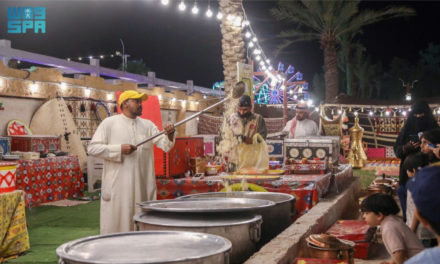
Rafha, Saudi Arabia —
“Al-Handa” stands among the best-known traditional performances in the north of the Kingdom, especially in the Northern Borders region. It carries the sound of inherited popular chants, and it also carries memory. In that way, the performance does more than entertain. It records a social world, preserves a local vocabulary of rhythm and response, and keeps a regional form of expression visible within the wider national story.
The practice reflects a cultural continuity that many communities recognize instinctively. Folk chants often survive because people repeat them at gatherings, pass them through families, and connect them to occasions that matter. As a result, “Al-Handa” becomes more than a performance style. It becomes a shared reference point, one that links older generations with younger ones through rhythm, repetition, and collective participation.
Heritage, identity, and belonging
Traditional chants often reveal how culture works at the local level. They do not need elaborate staging to matter. Instead, they depend on presence, voice, and remembrance. “Al-Handa” reflects that kind of cultural life. It documents a heritage shaped in the Northern Borders, while also reinforcing a broader sense of national belonging. In this sense, it shows how regional customs can strengthen the cultural fabric of the Kingdom without losing their distinct character.
That balance matters. When a local tradition remains recognizable, it preserves difference. However, when it also speaks to national belonging, it creates connection. “Al-Handa” appears to do both. It keeps a northern cultural form alive, and it places that form inside a wider understanding of Saudi identity. Such traditions remind observers that heritage is not frozen. It lives through use, performance, and the people who continue to value it.
A living form of cultural memory
The importance of folk performance lies partly in its ability to carry memory in audible form. A chant can mark a place, a season, or a community’s shared experience. For this reason, traditions like “Al-Handa” help document heritage in a way that written records alone cannot. They preserve tone, cadence, and social meaning. They also make culture feel lived rather than merely described.
In the Northern Borders, this kind of inheritance remains especially significant. It reflects the region’s place in the Kingdom’s cultural map and underscores the value of safeguarding popular arts. Meanwhile, the continued recognition of “Al-Handa” shows how traditional expressions can still speak clearly in the present. They remind audiences that national belonging often begins locally, in the customs people keep and the sounds they remember.
THE SAUDI STANDARD’S VIEW: HERITAGE AS A LIVING NATIONAL ASSET
Heritage is not peripheral to Saudi Arabia’s transformation; it is one of the foundations that gives modernization depth, continuity, and social meaning. Traditions such as Al-Handa show how regional identity can be preserved without being isolated, and how cultural distinctiveness can strengthen rather than dilute the national narrative.
• CULTURAL CONTINUITY BUILDS SOCIAL COHESION
When a local performance remains active across generations, it becomes a practical expression of belonging. That continuity matters because Vision 2030 is not only about economic diversification, but also about reinforcing the social fabric that supports long-term national progress.
• REGIONAL DISTINCTIVENESS ENRICHES THE NATIONAL STORY
The Northern Borders region contributes to Saudi identity through forms that are recognizably local and clearly rooted in place. Preserving those forms helps ensure that national development reflects the Kingdom’s full geographic and cultural diversity, rather than narrowing it.
• INTANGIBLE HERITAGE DESERVES CONSISTENT ATTENTION
Song, chant, rhythm, and communal performance are among the most vulnerable forms of heritage because their value depends on continued use. Recognizing them as part of the national cultural landscape supports a more complete approach to preservation, one that includes living practices alongside monuments and physical sites.
• CULTURE STRENGTHENS THE NON-ECONOMIC DIMENSION OF DEVELOPMENT
A successful national transformation is measured not only by infrastructure and investment, but also by the vitality of identity, memory, and shared meaning. Cultural traditions help anchor that broader development model by ensuring that progress remains connected to place, community, and inheritance.
As Saudi Arabia advances under Vision 2030, the preservation of living heritage will remain essential to a balanced national future. A confident economy is strengthened by a confident culture, and traditions such as Al-Handa remind us that modernization and memory can advance together in a manner that is both durable and distinctly Saudi.