SPA — North of Al-Laith, the Al-Razzan rock formations rise quietly from the surrounding landscape, shaped over thousands of years by erosion and seasonal water flow. More than a striking natural feature, Al-Razzan preserves a readable geological record that reflects how stone, climate, and human movement intersected in western Saudi Arabia.
Sheltered between Wadi Sa‘ya and Wadi Markoub, the site has remained largely untouched by modern development. Its layered rock surfaces, natural basins, and elevated paths reveal how geology supported early survival, guided movement toward Makkah, and continues to hold cultural and scientific value today.
A Landscape Shaped by Water and Stone
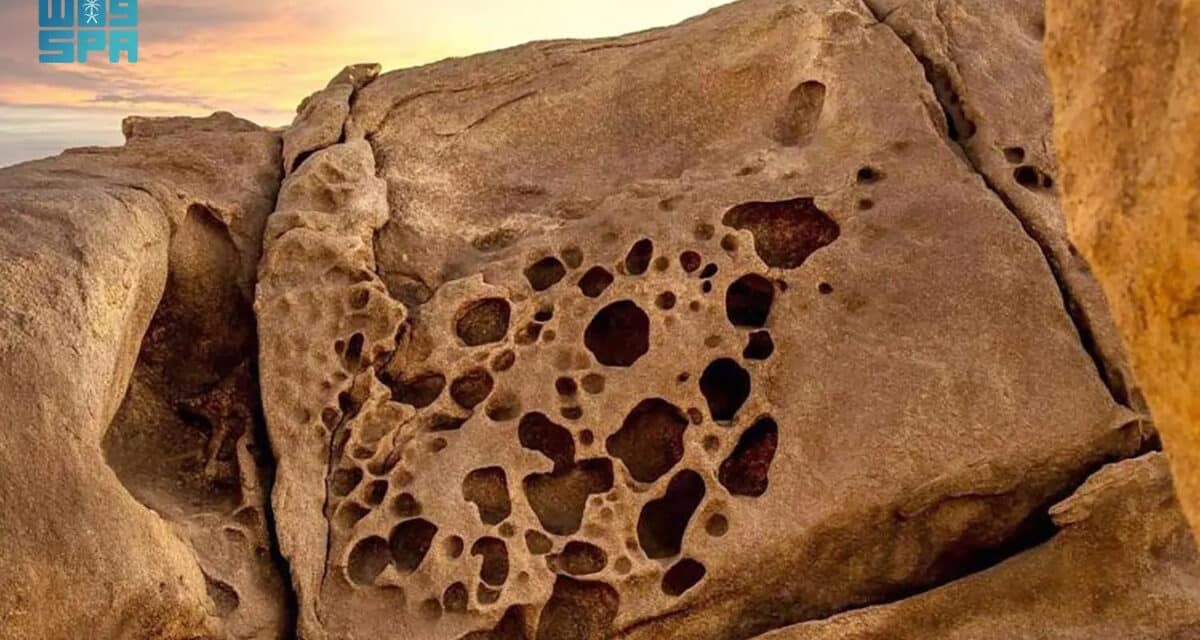
The Al-Razzan rock formations are arranged in compact blocks, stepped terraces, and natural stone ceilings. Seasonal floods carved these forms over thousands of years, leaving behind visible channels, flow lines, and smoothened surfaces. These markings are not decorative accidents. Instead, they document long-term interactions between water movement and rock resistance, offering geologists and visitors a readable surface history.
What distinguishes Al-Razzan is the balance between density and openness. Solid rock walls sit beside open voids and drop-offs, creating sharp visual contrasts between elevation and descent. As a result, the site feels less like a single formation and more like an open-air geological archive, where each surface records a different phase of environmental change.
Natural Basins as Early Infrastructure
Among the most notable features are the naturally formed rock basins scattered across the site. These depressions, shaped entirely by water erosion, once functioned as seasonal reservoirs. During rainfall, they collected and retained water, supplementing nearby wells. Local communities historically relied on these basins alongside sources such as Al-Khadra Well, integrating geological features into everyday survival strategies.
These basins underscore how the Al-Razzan rock formations were not passive scenery. They operated as functional components of a broader environmental system, long before engineered water storage became common. Their presence highlights an adaptive relationship between inhabitants and landscape, where stone formations served practical purposes without alteration.
Stone, Memory, and Oral Tradition
Beyond geology, Al-Razzan carries cultural meaning embedded in local narratives. One prominent standalone rock, known as “Hasat Abu Sade‘,” holds symbolic value in regional oral heritage. While physically unremarkable compared to larger formations, its recognition reflects how communities assign meaning to natural landmarks, weaving them into stories that outlast generations.
This cultural layer transforms Al-Razzan from a geological site into a place of memory. The rock formations become reference points not only for orientation, but also for identity, storytelling, and continuity within the local landscape.
A Route Carved by History
The elevated rock paths of Al-Razzan once played a strategic role along the Yemeni Hajj Trail. Pilgrims traveling north toward Makkah used the stable stone surfaces for visibility, safety, and protection. The terrain offered clear sightlines and natural guidance through an otherwise demanding environment.
This historical function illustrates how geology influenced movement and decision-making. The Al-Razzan rock formations were not obstacles to be avoided, but assets that shaped the route itself, reinforcing the connection between natural form and human mobility.
Geotourism Potential and Conservation Value
Today, Al-Razzan represents a high-value geological asset with potential relevance for geotourism and nature-based tourism initiatives. Its scientific features, visual coherence, and historical associations position it as more than a scenic backdrop. Instead, it offers opportunities to interpret Saudi Arabia’s natural history through place-based experiences.
Any future development would require careful stewardship. The value of Al-Razzan lies in its preservation, not transformation. By framing the rock formations as a living record of erosion, water systems, and pilgrimage history, the site aligns with broader objectives under Saudi Vision 2030, particularly those focused on conserving natural heritage and reintroducing underrecognized landscapes as cultural assets.
THE SAUDI STANDARD’S VIEW: Al-Razzan Rock Formations Preserve Saudi Arabia’s Geological Memory
The Al-Razzan rock formations north of Al-Laith Governorate stand as a rare convergence of geology, hydrology, and human history in western Saudi Arabia. Shaped by gradual erosion and seasonal water systems, the site reflects how natural landscapes have quietly underpinned settlement, movement, and survival—an approach to place that aligns with Vision 2030’s emphasis on conserving and reactivating national heritage.
• Geology as a long-term environmental record
The compact blocks, terraces, and carved channels of Al-Razzan document thousands of years of water flow and rock resistance. These visible traces transform the site into an open geological archive, offering insight into climate patterns and natural processes that shaped the western Arabian Peninsula.
• Natural infrastructure predating modern systems
Water-formed basins embedded within the rock formations once functioned as seasonal reservoirs, supporting nearby communities alongside wells. This highlights how geological features were integrated into daily life as practical infrastructure rather than passive scenery.
• Landscape continuity protected by geography
Situated between Wadi Sa‘ya and Wadi Markoub and distant from major development, Al-Razzan has retained its integrity. This natural protection underscores the value of geography itself as a conservation mechanism, preserving landscapes without extensive intervention.
• Cultural memory embedded in stone
Landmarks such as “Hasat Abu Sade‘” illustrate how communities assign meaning to natural features through oral tradition. These narratives elevate Al-Razzan from a geological site to a place of shared memory and identity.
• Geology shaping historical movement
The elevated rock paths of Al-Razzan once supported pilgrims along the Yemeni Hajj Trail toward Makkah. Stable stone surfaces provided visibility and guidance, demonstrating how natural form influenced historic mobility and route selection.
Looking ahead, the Al-Razzan rock formations represent a high-value opportunity for geotourism grounded in preservation rather than alteration. By interpreting erosion, water systems, and pilgrimage history through this landscape, Saudi Arabia reinforces its commitment to safeguarding natural heritage while reintroducing underrecognized sites as cultural assets—anchoring Vision 2030 in the deep memory of place.
Related Reading